
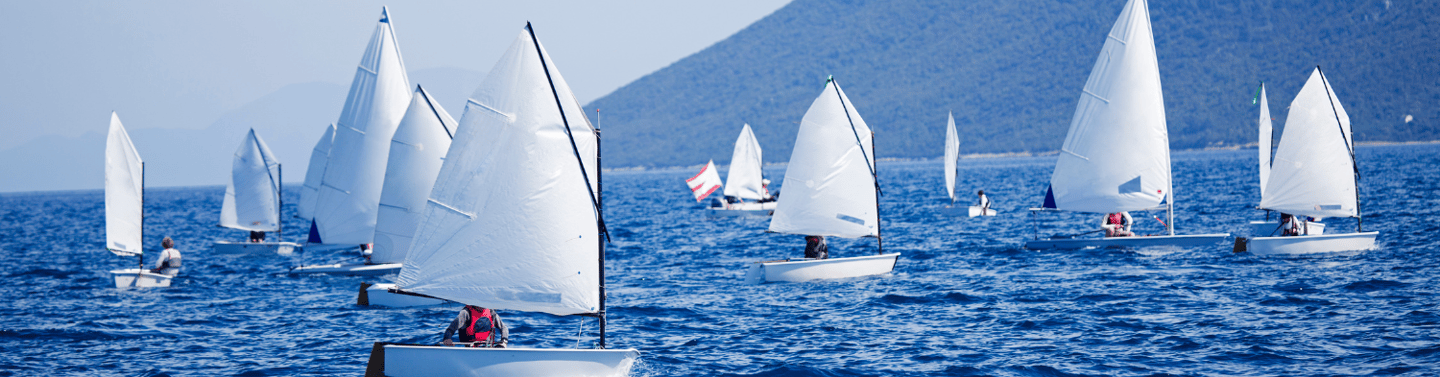

Intensive Dinghy Sailing Course
Objective:
Introduce participants to the basics of sailing on light sailing dinghies, with a focus on safe practice and building basic independence on the water.
Learn by doing: getting to know the equipment, steering the boat, and carrying out simple manoeuvres in real conditions.
Duration:
Total: 8 hours (split between theory and practice)
Suggested schedule: 10:00 am to 6:00 pm (with a lunch break)
Programme:
10:00 – 10:30 am — Welcome and introduction
Course overview and objectives.
Types of dinghies.
Main parts of the boat (hull, rudder, centreboard, mainsail, jib).
Wind basics: how the boat's position relates to the wind.
10:30 – 10:45 am — Quick briefing on land
Personal gear: life jacket, suitable clothing.
Basic safety: what to do if you fall in the water.
Wind and sail basics (with simple visual aids).
Rigging the boat together as a group (learning by rigging).
Note: theory is taught right in front of the boat, with everyone touching and seeing everything as we go.
10:45 am – 12:30 pm — Practice on land and launch
Basic manoeuvres on land: hoisting and lowering the sail.
Steering the boat on land using the rudder and mainsheet (simulation).
Launching: how to get in and out of the water safely.
12:30 – 1:30 pm — Lunch break
1:30 – 3:30 pm — Basic sailing on the water
Sailing in a straight line according to the wind.
Tacking (changing course against the wind).
Controlling speed and direction with the mainsheet and rudder.
Short routes between buoys.
3:30 – 5:00 pm — Building skills and exercises
Short courses (buoy circuit).
Introduction to gybing (turning with the wind astern).
Capsize recovery practice (optional, depending on conditions).
5:00 – 6:00 pm — Wrap-up and review
Packing away and derigging the boats.
Recap of what's been learned.
Certificates of participation or symbolic diplomas.
A few important notes:
Every student gets as much time on the water as possible.
You learn by doing, not by listening.
An instructor stays nearby in a support boat for guidance and safety.
The course adapts to the day's wind and each student's level, more technical when conditions allow, simpler in stronger wind.
Participants must know how to swim.
Recommended to bring: clothes you don't mind getting wet, suitable footwear, a cap, sunscreen, water, and a towel.
Key idea behind this course: learn by doing!
Students spend 80% of the time sailing and 20% listening to tips and feedback.
📱 +34 606085536
© 2025. Bigboy Sailing Experience